I’ve been keeping this under wraps, but it’s finally time to introduce you to someone who’s been living in my head—and soon, yours.
Meet Gemma Blackthorne: True crime podcaster. Relentless seeker of secrets. Obsessive solver of the unsolved.
Her specialty? Ancient, chilling mysteries buried by time. Her source? A shadowy group known only as The Need to Know Collective.
But there’s one mystery she’s never cracked.
Her father.
A world-famous magician who vanished—literally—mid-performance twenty years ago.
One minute: standing onstage.
The next: gone. Forever.
Some say he ran.
Some say the government buried him.
Gemma suspects something far stranger: that he opened a door into another dimension… and never came back.
Now, she’s about to unlock her most personal case yet.
And it all begins in a dusty little magic shop on Coney Island called Charm School, where the illusions never end—and neither do the secrets.
Cover reveal below! This is the start of something big.
A new mystery. A new heroine. And a story that may just rewrite history.
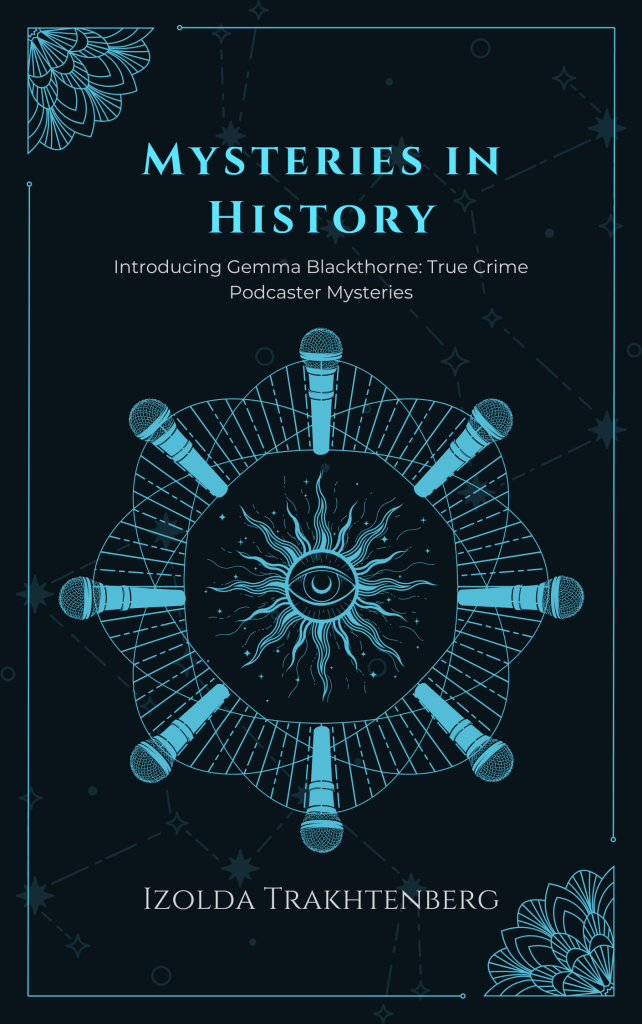
But why does the right book cover matter so much anyway?
A compelling book cover isn’t just decoration—it’s your silent salesperson. The top three things to think about when creating one are clarity, tone, and shelf impact.
First, clarity: your title and author name must be instantly readable, even as a thumbnail. Take a look at the cover. You can see the title of this piece from Topeka, and the font color both stands out and supports my brand. My author’s name is a little smaller, but that’s more because I have a long name rather than because I’m making it small on purpose.
Second, tone: your design has to visually match the genre and emotional feel of the story. A romance, thriller, fantasy, or nonfiction all have distinct visual cues. Take a look at the cover again. Does it convey the idea of something ancient and perhaps mystical? Do you see the microphones in the eight-sided figure that indicate tech and especially audio play a role?
Third, shelf impact: whether digital or physical, your cover has to stand out next to dozens of others. If it doesn’t catch the eye in one second flat, it’s not working hard enough. Go back to the cover. Does it catch your eye? Does it make you curious what the book is about?
I took just the center part and made it into my Facebook cover image. No words – just the graphic. The comments I received? “I’m curious.” “This looks cool.” “What’s this for? A new book?” And that’s exactly what I want to see from a cover. Build curiosity. Build buzz. Let your cover do some of the work, and the more work it does the more time you have to spend writing.
Think of your cover as a promise and make sure it’s one readers want to know. Go back to the cover once again.
If you’ve come this far …
I have a special gift for you. For the next few days, I’m making this story available for free to anyone who reads this post and wants to get the jump on this new book series.
Head here to grab your first summer beach read a little early!
 Izolda T
Leave a comment